Silicon Valley is an HBO comedy series that satirises the tech industry by following a group of socially awkward programmers as they build a startup while navigating the absurd, cutthroat world of venture capital, competitors, and their own interpersonal drama in California’s tech hub. I like it; I was even going to write a post about it while watching it, discussing how the show had little to do with programming at all and how money corrupts technology. There is a scene in Season Two of the show, where the team have had their product stolen from under them by a rival company called Endframe. Endframe has a prototype (as inferior as it may be) and is essentially ready to go to market, pending a deal. This is not something the team can just throw together to get out ahead of them, and first-mover advantage says even if they have the better system, they will likely fail if they don’t ship the code to the public first. Through a dubiously legal series of events, the guys end up with the specifics of the deal Endframe made, which they would be able to use to get a deal with the same company Endframe has. Thus, we have the core dilemma of the episode: Does Richard (the CEO) do something ethically dubious in order to succeed, or does he let socially acceptable moral standards prevail? As Guilfoyle says in the episode, “It is time to walk the Left Hand Path, Richard.”
The Left and Right Hand Path
If you have spent even a short time in occult circles, either online or AFK, you may have heard the phrases Left Hand Path (LHP) and Right Hand Path (RHP) thrown around. In many ways, both are as confusing as one another, and LHP can often be misconstrued for Satanism. The reality is more complicated, and gets further complicated by these spaces being filled with a combination of edgy teenagers dabbling with the occult more as a character accessory than actual spiritual leaning, and self-righteous neckbards that would give the BSD user-base a run for its money. The terms themselves originate from Tantric traditions but have evolved significantly in Western esotericism.
Right Hand Path
- Purpose: Union with the divine/universal consciousness
- Approach: Follows established traditions, hierarchies, and moral codes
- Self-concept: Seeks dissolution of ego into something greater
- Practices: Conventional rituals, devotion, prayer, meditation
- Examples: Mainstream religious mysticism, ceremonial magic focused on divine union, many New Age practices
Left Hand Path
- Purpose: Self-deification, spiritual independence
- Approach: Often transgressive, rejecting conventional morality and taboos
- Self-concept: Strengthens and evolves the individual ego/self
- Practices: Antinomian rituals, breaking taboos as spiritual practice, confronting the forbidden
- Examples: Certain forms of Satanism, some Luciferian traditions, Temple of Set
At its core, the fundamental differences are not about “good” vs “evil” as it is often characterised unintentionally by the previously mentioned groups. It is instead about internal vs external sources of authority, group vs individualistic incentives, and conformity vs transgressive solutions. To draw a parallel here, RHP is downloading directly from a server while LHP is using BitTorrent. Downloading directly from a server is socially acceptable but vulnerable to central authorities corrupting the platform. BitTorrent is dangerous, transgressive, but offers more freedom - even to do things that aren’t strictly speaking legal. LHP and RHP are therefore more frameworks to live by as opposed to overall implementation of a Dungeons and Dragons alignment compass - adopting LHP doesn’t make you a bad person just as adopting RHP doesn’t make you a good person. Both paths certainly have an aptitude for attracting certain personality archetypes, and one definitely lends itself to engaging in morally ambiguous if not ethically indefensible positions, but the reality of the situation is that people can and will interpret anything and everything to suit their needs. Much of the reason LHP is classed as being evil is that it became associated with figures like Anton LaVey and Aleister Crowley, both of whom are controversial figures within day-to-day thought.
“Why do I know so much about this?”
I am a complicated person. I was baptised a Christian, and growing up had an incredibly Christian family with my father being the church warden in one of the larger CoE churches in my area. Every Sunday I would go to church and help set things up, hand out booklets, and help my dad to monitor the sound system in church. I was also naturally curious and asked adults very difficult questions - when they could not answer these questions, I found my faith wanting. It was when I went to a multi-faith secondary school and found out atheism was even an option that I adopted this, much to the horror of my parents. I would often move between the camps of choosing to believe God does not exist at all, to the belief he does exist but blind belief in him was not justifiable. It was when I got to year nine that I discovered Marilyn Manson, and I came face to face with a real satanist for the first time, albeit through a computer screen. LaVeyan Satanists position themselves as their own God, creating their own reality through will and specialised knowledge rather than submitting to external authority - this is what Marilyn Manson was doing, and this fascinated me. At one point, I even began to call myself a Satanist, but dropped the title as time went on. Things escalated between sixth form and university. At one point, I got very into occultism and reading about it. It was only when I dropped out of my first university and got a job as a Bouncer that I actually took up Tarot reading. Things escalated from this point for several years, where I found myself getting very involved with occult and esoteric communities, and even ran a Discord server at one point to store and catalogue PDF files of texts ranging from Alchemy to Hoodoo. At this point, I also began to explore my Jewish roots, at one point I described myself as Jewish.
Fast forward to 2020, lockdown has started. Many people know that I got started in tech properly at this point; fewer people know this was also the point when I began to try and sort my life out following a messy breakup. I changed my worldviews drastically during this time, and came back to Christianity. I even at one point was very seriously considering becoming a priest. To this day, I am still Christian; I have some involvement with Judaism, but less and less so due to personal reasons. The closest thing I have to being involved with the occult and esoterica is Freemasonry, but this is a story for another time. This does not change the fact that I have employed LHP as a framework within my life, still as a Christian.
Cry about it, heretic
Despite what it may first appear, LHP and Christianity can go directly hand in hand; it just requires a slight reinterpretation of source material to do so. The truth is, when you strip away the edgy occult branding, the core LHP idea is “authority comes from the individual rather than institutions”, and this idea resonated with certain strands of Christianity. When Jesus Christ confronts the Pharisees, overturns tables, or rejects rigid interpretations of law, you could argue that he is acting transgressively against religious power structures. Under this guide, there is an important distinction to be made.
- Institutional Christianity operates under the guise of RHP
- Personal Relationship with God can resemble LHP philosophy
The main point of contention comes from the LHP framing of “self-deification”, which usually manifests as the individual becoming their own God. Traditional Christian theology rejects this, but there is a strange overlap - Christian theology has a concept called theosis where humans become “partakers” in the divine nature. This is not a fringe idea either, with it being heavily used within Eastern Orthodox teachings. The difference between this and traditional LHP is that, rather than the individual becoming divine through will, the individual becomes divine through God.
My relationship with both is this - I fundamentally use Christianity as a framework to be a good person, believing there are consequences to my actions, and when I die, I will need to answer for myself. I use LHP as a framework to understand that being able to answer myself and being able to answer God are essentially one and the same thing. The Church plays little role in my relationship with God, just as the state plays little part in my relationship with myself. This assertion can and will be met with disdain and disgust from both sides of the spiritual camp, and to both I say this:
- To Christians: You are taught not to worship objects, the Church as an institution becomes that object. I encourage you to question your own beliefs and whether it is something you have adopted because it came from them or if it aligns with your own Christian values.
- To LHP Practitioners: Merging LHP and Philosophy angers you because it is Christianity, and in many cases you adopted this philosophy to rebel against it. In doing so, you created a dogmatic ethos you all submit to, from which there is no escape, causing the transgressive to become the non-infringed. Combining the two is the most transgressive thing you can do.
Now… despite that mini essay on my personal relationship with occultism and Christianity, this post was never supposed to be about that, and I move on to the crux of the post.
IaCAAG - Infrastructure as code as a Grimoire
I have established in many of my posts at this point that I have adopted a GitOps workflow in my homelab, with the end goal of defining the entire architecture, configuration, and deployment using IaC. This method works for me, I like knowing that I can tear down and resurrect entire systems with minimal effort because I have built a robust and sound blueprint months prior. The Declarative approach feels like arcane knowledge to those who have just started their journey into homelabbing, and in many ways it is. I like the Thor quote that “magic is just science we don’t understand yet”. Raising and levelling an entire homelab with a few commands is effectively the same as a Warlock raising and levelling entire civilisations using a spell. The fact that we understand how the former works is relative. The interesting part isn’t that either of these ideas is transgressive. The interesting part is how discovering them changes the way you see systems.
The fact here is this - neither LHP nor GitOps are transgressive ideas, and I am not sorry if that upsets or offends you. Both are widely adopted by the groups the ideas circulate between, and both make sense if/when you fully grasp what they are trying to achieve. Neither is actually forbidden knowledge — it just feels like it when you first discover it. The reality of the situation is that most occult communities are just nerds reading old books and arguing on the internet, and GitOps engineers are just nerds writing YAML and arguing on the internet. The only difference is whether the book contains YAML or ritual diagrams. You are not outsiders; you just need a shower.
The reason GitOps and IaC feel so powerful to people encountering them for the first time is that they fundamentally change the way infrastructure is interacted with. Traditional infrastructure management is imperative: you log into machines, run commands, install packages, configure services, and hope you wrote down enough notes that you can repeat the process later if something breaks. Infrastructure as Code flips this model on its head, where instead of manually constructing systems piece by piece, you describe the system you want to exist and allow software to converge reality to that description. Servers stop being machines you care for individually and instead become disposable outcomes of a written blueprint. Most of us first notice the rabbit hole when we discover that logging into a system, configuring users, hardening SSH, and installing packages can all be done via a script; some may even stick their head into the rabbit hole with Ansible. By the time you discover NixOS, Terraform and Docker Compose, it is already too late, and it’s best to just let the inertia take control. Thus is the initiate’s path from sorcerer’s apprentice to master mage.
As soon as you cross this threshold, the config files stop being config files. YAML blocks, Terraform modules and Nix expressions stop being documentation and start becoming descriptions of reality itself. Instead of performing actions step by step, you bring it into existence - the only limit is how you describe the plane you are transforming. If the description is correct, the infrastructure appears; if the description is wrong, the spell fails, and you spend the next hour staring at logs trying to figure out which part of the incantation you mispronounced.
A traditional grimoire was simply a book containing spells, rituals and annotations from previous practitioners, often passed around communities of people. They were rarely written to be easily understood by outsiders. A Git repo containing infrastructure definitions ends up serving a remarkably similar role. It is a written record of how systems should exist, complete with revisions, comments, and historical context explaining why certain decisions were made. The commit history becomes the lineage of the spell. It documents how the wording of the ritual evolves until it produces the desired outcome. Tooling is just the method used to incant the spell written in the grimoire: tofu apply; nixos-rebuild switch --flake .; CI/CD pipelines triggered by a commit to master. These commands are the incantations that translate written definitions into running systems. When the ritual succeeds, infrastructure appears exactly as described. When it fails, you begin adjusting the wording of the spell until reality behaves correctly.
This quietly gives the practitioner power over the entire environment. When infrastructure is defined entirely in code, creation and destruction become symmetrical operations. A few commands can raise an entire cluster into existence, and a few commands can destroy it just as easily. There is a quote in Dune, “the power to destroy a thing is the absolute control over it”. You see, without IaC, you do not have the power to destroy your homelab - every VM represents time invested, hours of troubleshooting and tweaking. To tear it down in that state would represent wasted time, effort, and likely the choice to abandon and never come back. IaC allows me to flatten my server tomorrow and be back up and running in a matter of hours. It expands the Dune quote, because this is not just the power to destroy a thing, it is the power to destroy it without consequence. Servers are no longer fragile pets under this philosophy; they are disposable cattle.
Walk the path
This brings me back to the line from Silicon Valley that inspired the title of this post. Whenever one of my friends crosses that conceptual threshold and starts experimenting with declarative infrastructure for the first time, I usually respond with the same phrase Guilfoyle used in the show: “Welcome to the Left Hand Path, brother.” It started as a throwaway joke I have with myself, but it stuck around because it perfectly captures that moment where someone stops interacting with systems manually and starts manipulating the rules that define them.
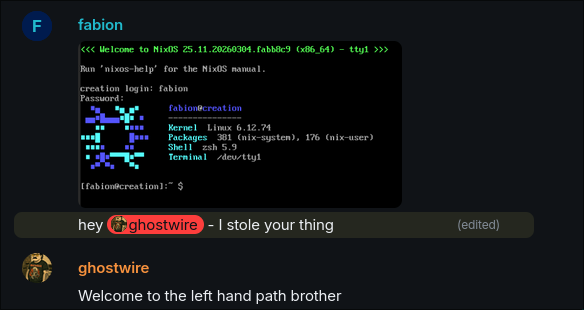
The Left Hand Path was never really about rebellion. It was about understanding the system well enough that you no longer needed to follow it blindly. Once you understand the system, you realise you were never breaking the rules — you were just learning how to write them.
Verify this post
This page is published as a PGP clearsigned document. You can verify it like this:
gpg --keyserver hkps://keys.openpgp.org --recv-keys CA98D5946FA3A374BA7E2D8FB254FBF3F060B796
curl -fsSL 'https://eddiequinn.xyz/sigs/posts/2026/march/welcome-to-the-left-hand-path.txt' | gpg --verify